

Clicking Is Not the Same as Learning: Teaching Students to Use Hints Effectively


Picture a familiar classroom moment. During an ASSISTments assignment, you’re helping one student while several other hands are raised. Another student selects Get Help, reads a hint, labels a diagram, and tries again. The hint provides immediate support, helping the student move forward while you can work with someone else.
Across the room, another student opens hint after hint without pausing to apply the new information. Both students selected Get Help, but only one used the support to move their thinking forward.
As an ASSISTments coach, I encourage educators to think beyond whether students access hints and instead focus on how they use them. Hints can be an effective learning strategy when students are taught beyond where to find them. When used strategically, hints can help students take the next step without simply giving away the answer. But students may click without reading, applying the information, or returning to the problem altogether. They often need explicit instructions on how to use hints effectively.
Research identifies effective help-seeking as part of self-regulated learning. Rather than simply knowing that help is available, students need to recognize when they are stuck, identify what support they need, and use that support to move their thinking forward. Research suggests that these skills can be strengthened through explicit instruction and feedback that helps students use help productively.
Here’s how I recommend helping students turn ASSISTments hints into a learning strategy.
Why Hint Use Matters
ASSISTments hints are available when students request them, giving students an opportunity to seek help when they need it. Research by ASSISTments cofounder Neil Heffernan and Leena Razzaq examined on-demand hints compared with hints that appeared automatically after an incorrect answer. Their findings suggest that on-demand hints can support student learning more reliably. The effect was especially strong among students who frequently requested help. (Razzaq and Heffernan, 2010).
When I talk with teachers about hint use, I frame selecting Get Help as a productive decision: “I’m stuck, and I need information to move forward.” The goal isn’t to discourage students from seeking help, but instead to teach students what to do with each hint.
My recommendation is simple: Open one hint. Use one hint. Then try again.
A Coaching Strategy to Try: The HINT Routine
One strategy I recommend is introducing a short routine that students can follow whenever they access an ASSISTments hint. Model it with an actual ASSISTments math problem so students can see what productive help-seeking looks like.
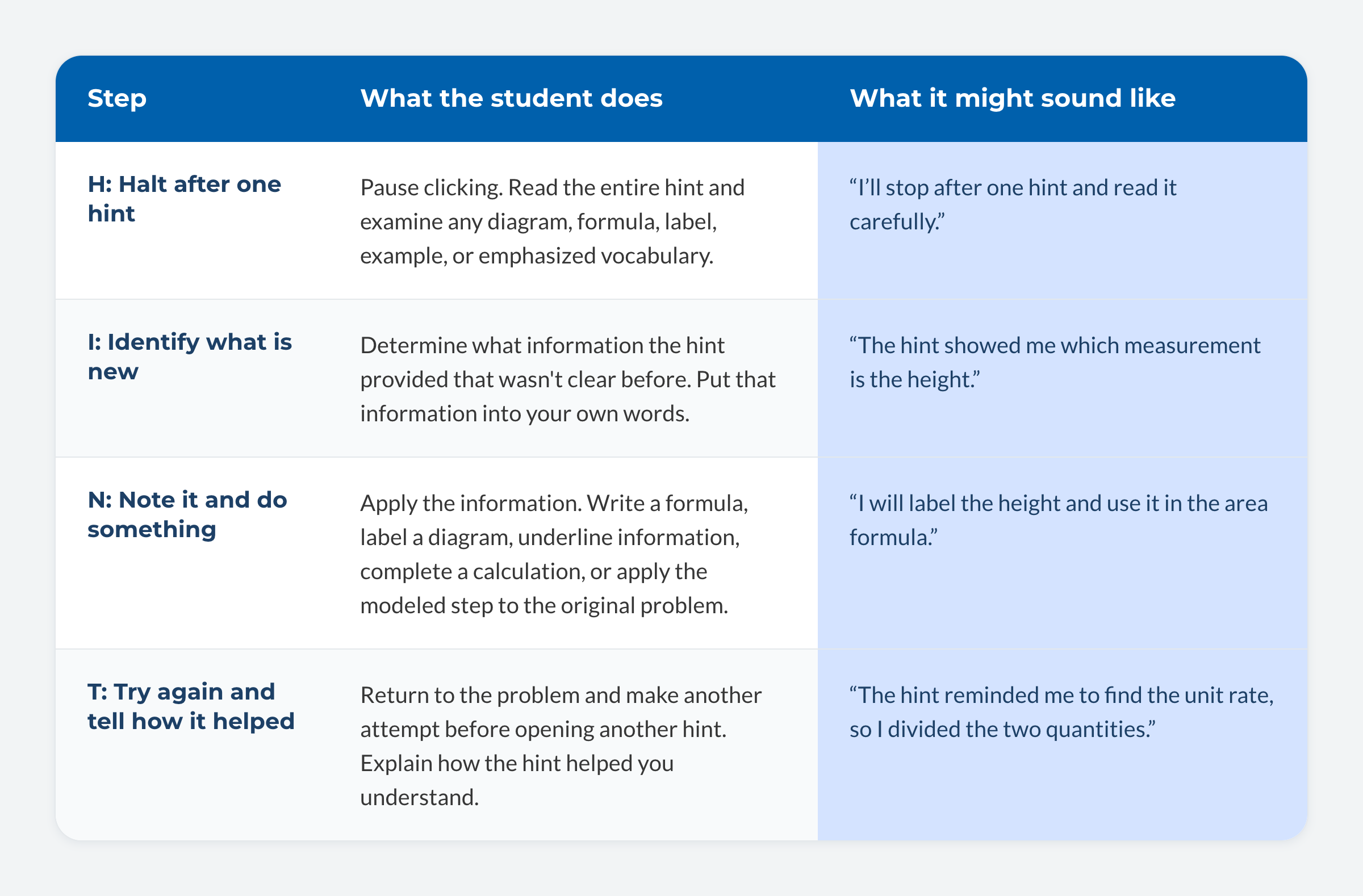
I emphasize the Note it and do something step because it asks the student to act on the information rather than simply reading and moving on.
To help students reflect on their thinking, try this sentence starter:
The hint helped me because it showed or reminded me __________, so I __________.
This simple reflection encourages students to connect the support they received with the action they took. It also makes their thinking more visible to you as the teacher.
The Education Endowment Foundation's guidance on metacognition reinforces the value of explicitly teaching learning strategies, modeling thinking aloud, and gradually reducing support as students become more independent.
Model Productive Hint Use in a Lesson
Posting a routine is rarely enough. I encourage teachers to make their thinking visible during a whole group lesson by projecting an ASSISTments problem and thinking aloud. For example:
I’m not sure how to use this diagram, so I’ll select Get Help. I’ll stop after one hint and read it carefully. The hint added a line labeled height. I'll label it on my paper, use it in the area formula, and try again.
This models the full process of the HINT strategy: recognizing a need for help, interpreting the hint, applying the information, and attempting the problem again. I also recommend modeling how to recover after unproductive clicking: “I opened multiple hints without applying any of them. I am returning to the first one, identifying what it added, and taking one action.” This shows students how to reset without shame.
Reinforcing the Routine During Instruction
As students work independently, brief prompts such as, “What new information did the hint give you?” “Show me what you did with it.” or “Try again before opening another hint.” can help them build a productive habit. After several clicks, you can ask the student to return to the first hint, identify the new information, and take one action.
Reinforce the routine during a whole class discussion using the assignment report. After identifying a challenging problem, display it with the first hint and encourage students to discuss what the hint adds and what they could write, label, calculate, or revise before trying again. This connects productive help seeking to learning from real assignment data.
Over time, you can reduce the prompts and encourage students to ask these questions themselves. The goal is for the routine to become a habit students can use independently when they recognize that they are stuck.
Bringing the Conversation to Teacher Teams
In coaching conversations, I invite teacher teams to examine one problem and its first hint. I might ask: What new information does the hint provide? What could a student physically do with it? What does productive hint usage look and sound like in your classrooms? These questions support shared expectations while leaving teachers room to decide what fits their students.
This week, choose one ASSISTments problem and model the HINT routine with students or teachers. Show them that selecting Get Help is only the beginning: read the hint, apply what it teaches, and try again.
When students learn how to use hints effectively, they build a skill that extends beyond a single ASSISTments assignment: knowing how to seek support, act on feedback, and take the next step when a problem gets difficult.
Share on socials!


