

How to Choose an Evidence-Based Math Program (ESSA Ratings Explained)
.svg)

.svg)
.svg)

Hundreds of math intervention programs compete for district budgets every year, yet only a small percentage hold a Tier 1 ESSA Strong Evidence rating backed by rigorous research. That creates a serious challenge for district leaders, instructional coaches, and curriculum directors trying to separate marketing claims from proven results.
Choosing the wrong program wastes more than money. It costs valuable instructional time for students who already need additional support. The best programs improve achievement, fit into existing classroom workflows, and provide independent evidence that they work at scale.
This article explains what ESSA evidence tiers actually mean, why they matter for funding and student outcomes, and how to evaluate evidence-based math intervention programs before making a purchasing decision.
What Are ESSA Evidence Tiers?
The Every Student Succeeds Act (ESSA) requires schools and districts to use evidence when selecting instructional programs and interventions supported by federal funding.
ESSA organizes evidence into four tiers:
Most research based math interventions on the market fall into Tier 3 or Tier 4. That does not automatically mean they are ineffective, but it does mean districts have less independent proof that the program consistently improves student outcomes.
Tier 1 and Tier 2 programs are much rarer. These programs have undergone stronger evaluation methods, making them safer and more reliable investments for schools looking to improve achievement through math intervention.
Districts can also review independent evaluations through the What Works Clearinghouse and Evidence for ESSA.
Why Evidence Ratings Matter for Your District

Evidence ratings directly affect funding eligibility, purchasing decisions, and accountability expectations.
Many federal and state funding programs strongly prefer or require districts to adopt interventions supported by ESSA evidence tiers. Title I funding, competitive grants, and other school improvement initiatives increasingly prioritize programs with Tier 1 or Tier 2 evidence.
Strong evidence also reduces risk. District leaders are expected to justify curriculum and intervention spending to school boards, families, and state agencies. Choosing an intervention program in mathematics without validated results can be difficult to defend when budgets are tight.
Student outcomes matter even more. Programs with higher evidence ratings have already been independently studied in real classrooms. Districts can move forward with greater confidence that the intervention supports learning gains rather than relying on vendor promises alone.
The best math intervention curriculum solutions also provide ongoing visibility into student progress. Independent reviews from organizations like the What Works Clearinghouse help districts verify whether programs actually improve achievement across diverse student populations.
For districts trying to balance academic recovery, teacher workload, and long-term achievement growth, evidence matters because it helps narrow the field to programs with measurable impact.
What to Look for When Evaluating Math Intervention Programs
Not all best math intervention programs solve the same problems. Some focus on practice only. Others provide adaptive support, instructional insights, or curriculum alignment. District leaders should evaluate programs using a consistent framework.
1. Evidence Rating
Start with ESSA evidence. Does the program hold Tier 1 or Tier 2 status? Has it been independently reviewed by the What Works Clearinghouse?
Many vendors reference “research-based” strategies, but that is different from validated outcomes. Strong evidence should come from independent studies, not just internal case studies.
2. Curriculum Alignment
A good math intervention curriculum should supplement your existing instruction, not force teachers to replace everything they already use.
Look for programs that align with state standards and popular curricula such as Illustrative Mathematics, Eureka Math, or Open Up Resources. This reduces implementation friction and improves teacher adoption.
3. Immediate Feedback for Students
Students learn best when they can correct mistakes in real time. Effective research based math interventions provide immediate feedback, hints, and support while students are actively solving problems.
Delayed grading reduces the impact of intervention because misconceptions remain unaddressed for too long.
4. Actionable Teacher Data
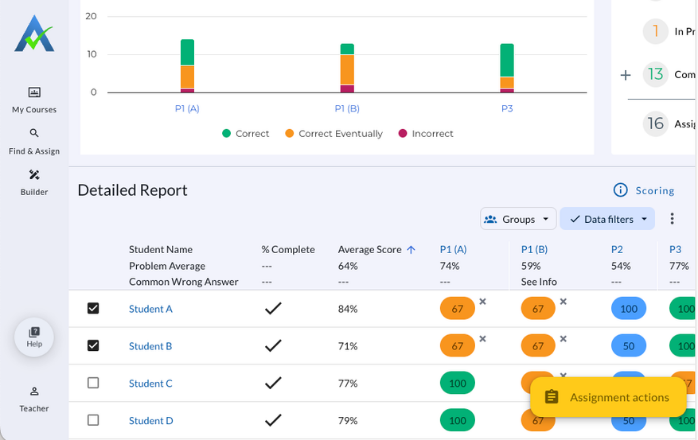
Teachers do not need more dashboards filled with disconnected numbers. They need reports that identify where students are struggling and what concepts require reteaching.
Programs with strong analytics can support targeted small-group instruction and more efficient intervention planning. District leaders should review the quality of reporting tools before adoption. ASSISTments offers detailed reporting through its Data Reports features for teachers and schools.
5. Flexibility for Classrooms
Schools use different instructional models. Some classrooms are fully digital. Others rely heavily on paper-based instruction.
The strongest math intervention programs support multiple workflows. Flexibility matters because rigid systems often create implementation problems that reduce teacher buy-in.
6. Cost and Accessibility
Pricing should be transparent and sustainable. Some programs charge large licensing fees that become difficult to maintain after grant funding expires.
District leaders should also evaluate whether teachers can access free tools before districtwide adoption. Nonprofit models can provide additional value and mission alignment.
7. Grade-Level Fit
Not every intervention works equally well across all grade bands. Make sure the platform is designed for your target student population, whether elementary, middle school, or high school.
How ASSISTments Meets the Evidence Standard

ASSISTments is one of the few nonprofit math platforms with a Tier 1 ESSA Strong Evidence rating supported by randomized controlled trials. That distinction places it among a very small group of truly validated evidence-based math intervention programs.
The platform also received a “Positive without reservation” rating from the What Works Clearinghouse, which is considered one of the strongest independent endorsements in K-12 education research.
In practice, ASSISTments works differently from many standalone intervention tools. Teachers can assign problems directly from their existing curriculum rather than replacing core instruction. This helps districts strengthen intervention without disrupting classroom continuity.
Students receive immediate feedback and hints while solving problems. Teachers receive detailed reports that pinpoint misconceptions and identify where intervention is needed most. Districts interested in implementation details can explore how ASSISTments works for districts.
One major differentiator is workflow flexibility. Teachers can print assignments, students can complete work on paper, and then answers can be submitted digitally for auto-grading and reporting. This print-plus-digital approach helps districts address screen time concerns while still benefiting from real-time data.
ASSISTments also supports accessibility features such as read-aloud tools and curriculum alignment with major instructional programs. Teachers can learn more through the Product for Teachers page.
As a nonprofit organization backed by Worcester Polytechnic Institute, ASSISTments has served more than 1 million students since 2019 and provides access to more than 200,000 math problems. Research studies have also shown up to 60% more growth in math scores compared to traditional homework approaches.
The core platform remains free for teachers. Districts looking for expanded analytics and targeted intervention support will be able to access ASSISTments Plus, launching in July 2026. Pricing details are available on the Pricing page.
Frequently Asked Questions
What is a math intervention program?
A math intervention program is a supplemental instructional tool designed to help students who struggle with grade-level math concepts. These programs provide targeted practice, feedback, and instructional support to help students catch up.
What are good math intervention programs?
Good math intervention programs have Tier 1 or Tier 2 ESSA evidence ratings and independent validation from organizations like the What Works Clearinghouse. ASSISTments is one example with both a Tier 1 ESSA Strong Evidence rating and a positive IES review.
How much does a math intervention program cost?
Costs vary widely depending on features and licensing models. Some platforms charge districtwide subscription fees, while others offer free teacher access. ASSISTments provides a free core platform for teachers, with additional district features available through ASSISTments Plus. More details are available on the ASSISTments Plus Pricing page.
Conclusion
Choosing a math intervention program is one of the most important academic decisions a district can make. ESSA evidence tiers provide a practical framework for evaluating whether a program has proven results or simply strong marketing.
As districts face increasing pressure to justify spending and improve outcomes, programs without rigorous evidence will become harder to defend. Tier 1 and Tier 2 programs offer greater confidence that instructional time and funding are being used effectively.
ASSISTments combines strong research validation, curriculum flexibility, immediate student feedback, and actionable teacher data in a nonprofit platform designed to support real classroom needs. District leaders can see the evidence behind ASSISTments and explore whether the platform fits their intervention goals.
Share on socials!



.avif)
.avif)


